Sunday, August 6, 2017

Sean Forbes Landmark CD Perfect Imperfection


Sean Forbes

Perfect Imperfection


Sean Forbes grew up in a musical family. His father Scott and Uncle Dennis founded the iconic Forbes Brothers Band giving country rock new meaning and substance. Both Scott and Dennis are Michigan rockers at heart and have compiled impressive songwriting credits. Dennis is the techno wizard of the clan and engineered some of Bob Seger’s best recordings from the seventies. Given the Forbes family history Sean was destined to become a musician. It was in his blood like oxygen is to breathing. He’s been charting his path since toddlerhood when he showed an affinity for beating on the drums. For Sean it was the roar that lies on the other side of silence. It helped him to defeat the dark solitude of being deaf. At times it could be heavy like living in a cave and not being wanted. Yet he was loved dearly and his parents helped him go beyond those moments in which he felt small and frail. As his keening senses evolved, he could smell the air of the house he was born into. Sean has an uncanny power to feel voice tones and unearth vibrations hidden from others. He could feel the phantom buzz and for him it was an elegant surrender to his musical heritage.  Sean learned about love from his parents and he became a champion of those who are not loved. It is no small coincidence that Sean founded the Deaf Professional Artists Network (D-PAN). It is an organization that supports the arts and sciences to people who are deaf. D-Pan has created a network of services and learning opportunities for anyone interested in pursuing a dream

Sean’s first full length CD Prefect Imperfection is the culmination of a life long quest for the lost chords, beats and rhythms derived from the universal note. In making the music in his mind, Sean has created an entirely new genre of musical expression. There is nothing past or present that can compare to what Forbes has dished out on his platter, a feast for the gods; a search for the Holy Grail. Forbes is an alchemist forging an innovation never imagined; a disciple of Mary Shelly imparting the secrets of love and immortality. Forbes has created a new living/pulsating work of art. He is a lone genius crafting rhythmic patterns, music for the soul. Pay attention, this just may be the last great musical innovation in our lifetime. Forbes may be a post-modern Robert Johnson standing at the crossroads between sound and silence. Forbes is beginning to understand that he is not the sum of other people’s prescriptions and that dialectical dilemmas exist in the music biz; rebel versus slave; to dominate versus being victimized. He is on a moral high ground, making choices to help others through D-PAN. His heart reaches out and touches a deep well of love and peace that still exists for humanity. It is a brave new world in which a very literal culture takes more stock in material acquisition and the cult of celebrity over deep moral interests. It can prove to be unsatisfying. In this world water is only H20. Forbes is the exception to the rule. He is deeply aware of his longings, his selfdom. You can feel it in his beats and read it in his lyrics. Scott now lives in a complex web of relationships never before imagined from Eminem and Stevie Wonder to actress and mambo queen Marlee Matlin. Yet through all this buzz of fame and notoriety, Sean has kept his head on straight. It’s deeply imbedded in his genetic code.

His music tells a story of struggle and triumph.. Forbes is able to bring his head and body together and move from the heart. The message is transcendent

We Interrupt This Program

The disc opens with a statement by Franklin Delano Roosevelt recorded at his First Inaugural Address in 1933…

“So first of all, let me assert my firm belief, that the only thing we have to fear is fear itself”

This is a catchy mid-tempo rap with rock steady beats with light percussion and synthesized clips and washes


I’m Deaf

Deafer than Def Jam. This is a love song, a message to everyone who is hearing impaired and anyone who misunderstands the needs and strengths of people who are deaf. The emotions run high and are not sugar coated or minimalized. Sean’s message is not all about peace and love. It’s about frustration, communication and do-gooders who invalidate differences. Sean admits that he isn’t about to let anyone discount his intelligence or his craft. He admits that his hands talk dirty, so do mine, like a middle finger salute. But Forbes shifts gears and lists of people who have inspired him such as Jim Abbott, Helen Keller and Stevie Wonder. The cat on the keyboards pounds out minor chords and fills out the soundscape. At the Coda he plays a more intricate phrasing that conveys a deeply felt emotional valence

Crazy About You

The music is sophisticated minimalist phrasings reminiscent of early 10CC. Forbes vocals are up front in the mix. Female singers enter the song with a sultry chorus

Crazy About You

Crazy About You 

Crazy About You (I can never get enough)

Love the line about the struggles of maintaining a deep love relationship –

Building a foundation

But there’s no furniture in the house

PERFECT


Do You Know What I Mean

Forbes handles the 100 mile an hour breakneck speed verses. His vocal is stylistically adroit and powerful, almost breathless. The sing/song chorus has the hooks. Howard Kaylan would be proud and smilin’

 Do you know what mean

Watch These Hands

 This song has a 59 second interlude (chill out) motif that has an unmistakable Stevie Wonder vibe. It’s a song about real communication, not the newspeak and doublethink predicted by Orwell and others so many years ago. Forbes attempts to communicate deeply, almost religiously instead of obfuscating and attempting to control thinking. He has hands that talk, lips that move and eyes that see. He leads us by the nose to rediscover the non-verbal ways of telling a story. Whew this is a double plus good belly feel.

Def Deaf Girls

Forbes is signifying about more than recognizing the sensuous delights of deaf girls; this is loin bumping, tongue-twisting and deep throated eroticism. It is an ethological imperative; our instinct to be social and merge with others. This is a cultural coming of age statement, a signal that the train is coming down the track and speeding through the tunnel; hopping in the backseat for some homegrown lovin’. Forbes gets that familiar groove pulsating with the beat. It’s vice tight and fits just right, like jellyroll rockin’ my soul. Lord Have Mercy.

Bob Dylan was the First Rapper

Great song with a stolen verse from Dylan’s apocalyptic Subterranean Homesick Blues. The chorus with unison singing just sloppy enough to make it real


Gordy Garris has a great New CD - Never Give Up


Gordy Garris


Acoustic strum


Garris learned the hard way, feeling his way through a thicket of popsters from Andy Reed, the Legal Matters, Chris Zehnder and Donny Brown. They own the crown of creation in the backwoods of the Great Lakes Bay Region even when people are not listening closely. This writer has heard the word and bows down to the great wealth of music in our own backyards. Andy Reed is an icon to me and his productions are incredibly intricate. The delicate soundscape he creates is right on par with Alex Chilton, Big Star and the early power pop of The Frost, an incredibly gifted band that included Dick Wagner, Donny Hartman, Gordy Garris, and Bobby Rigg.  As fate would have Gordy Garris Jr. has inherited his father’s gift for music, harmony and lyricism. This document is a testament to the abiding craft that has emerged in the hills and valleys of Bay City, Midland and Saginaw.


Let me in is a great opener. “It’s you – you will let me in”.  Garris has a fine tenor that can reach the high notes without any squawk’s and strain. The drum brings in a subtle backbeat, followed with electric guitar, bass, piano, and Maiya Kauffman’s understated violin. Nice Riff. Garris intones “No one there to save you now, just to find your way.” This is a song of recovery and hope. The message is powerful. “When your dreams all fail and you lost your way, don’t give up on your dreams”.  Good times open with a reggae beat and a throbbing bass guitar the singer becomes the song and his lyrical scripts convey hope even when it is painful. “If you waste your life thinking then you’ll miss out on the good times. Don’t miss out”.  In all that I want – Moving faster than the speed of light but you can’t catch her. She’s out of sight; she’s all that I want. Garris is in a funky Jones. He’s got it bad. The drummer provides a vocal counterpoint; creates a colorful landscape with Reeds red hot guitar clips.   Nobody’s there opens with what sounds like a church organ or a piano and violin. It has an eloquence that is captivating;

“Through the mist I saw nothing at all until I saw you standing there.

You’ve come along way – just to say – I’ll be there for you”

Garris has a sweet tenor and he sings like a bird. He’s grown in Leaps and Bounds as a singer/song writer. Andy Reed is hovering over it all, his engineering is fabulous. He positions the bass guitar for a thumping good bottom with a cool synth/guitar workout.  Stole my heart. Gordy’s piano trill is spare and tight; it gives Garris’ vocal space to breathe. I wrote the song for you and it’s the only thing I can do to let you know, know the truth you stole my heart. Garris’ tenor is strong and evocative. Garris piano and Maiya Kaufmann’s violin gives it substance and a major chord ambiance. Move me has an acapella intro. “Give won’t give in.” Acoustic strum is followed by tight drums and vocal aside, “The way you move me, the way you feel me.” His wondrous vocals are up front, he’s loose and ready to riff. Reeds command of the vocal harmonies is exquisite, incredible.

 Space – Scratch picking opens the song. It has a heavy bottom with a cool electric phantasm that leads to a heavy metal power pop eye opener. There is a nice E-string workout in the middle. Dick Wagner must be smiling up in those clouds. Garris goes environmental like Al Gore on an iceberg that’s melting. He’s worried about this crazy life. He surrounds me. Can’t you see (sings), what’s become of me?”  Wasted Man starts with a riff that sounds like Carlos Santana praying to the Heavens. Reed sings counterpoint to Garris and builds the harmonies with tremolo guitar accents and Kaufman’s wall of sound violin is exquisite, brilliant. Remember me; Garris opens with acoustic strumming and vocal harmonies with Reed. Garris recalls a past courtship that didn’t work out. Tears were over the memories. He won’t give in but he’s sitting on the fence. It doesn’t bode well. His tears were about fading memories. He does not want to give-in though he’s sitting on the fence afraid the egg will crack. It doesn’t bode well.

 Out of my mind Garris opens the song with electric guitar and a cool acoustic workout. The blended harmonies are exquisite. The drummer does a powerful double time riff like Mick Fleetwood pounding out the beat on Green Manalishi. There’s anger in the vocal. It’s about a failed relationship. Garris sings, “I must be out of my mind”.

The Coda:

Believe me. Sweet Piano trills and softened bass bring the song into context. The singer’s righteous tenor scaffolds the musical landscape of young love. Garris sings his heart out, “Don’t ever give up on me no matter what you do, I won’t give up on you”.


Gordy Garris has written great material that fits perfectly in this saga of love and loss . His singing is powerful. His tenor is strong. His writing is accomplished. He was able to build lyrical castles in each moment of this incredible song cycle. Garris is on his way up!


Take One! Arian Kerridge Book Review


                                               Tape’s rolling,

                                           Take One!

                            The recording life of Adrian Kerridge


Adrian Kerridge is an obscure English producer, hardly known outside of Great Britain despite his six decades of recording, arranging and producing rock & roll television scores and movies. Kerridge fashioned 14 chapters from 319 pages of his remembrances of the music industry. He first hit pay dirt in 1954, working as a young lad at IBC studios. He learned his chops and eventually bought Lansdowne Studio and through his ascendance, Kerridge solidified his ranking in the new British aristocracy and became a true musical icon. He initially befriended Joe Meek who taught Kerridge about close mic placement, multiple over-dubbing, direct placing of bass guitars, the compressor, and effects such as reverb and echo as well as sampling. Kerridge felt that Meek was a genius and that his life style as a hidden homosexual was cause for arrest and imprisonment. It made him a target in polite society. Kerridge and Meek became close friends and they collaborated on many of the sessions at the IBC studios. At high recording levels, the one quarter inch tape noise was in significant and it allowed Meek to create several composite overdubs with only a negligible loss of sound quality. This technique allowed singers such as Petula Clark and Shirley Bassey to belt out the lyrics. On February 3rd, 1967 Meek killed his landlady, Violet Shenton and then shot himself. At the time of his death, he possessed thousands of unreleased recordings that later became known as the Tea Chest Tapes.

Denis Preston owned the Lansdowne studios and it was an approved studio on the Musicians Union “fair list.” Though Kerridge never understood why it existed for studios and for what purpose.  However, Preston wanted to make Lansdowne the best-equipped studio for sound recording in London and in Europe. Denis conceded that George Martin (Beatle Producer) and Geoff Emerick (balance engineer who recorded the Beatles. Kerridge feels that they changed attitudes at Abbey Road, making more accessible

Chapter 9 was the most interesting part of the book as it was exclusively about the Dave Clark 5.  Kerridge first met the Dave Clark 5 in 1962 when they came into the studio for demo work. It turned out that Lansdowne was the first proper studio they experienced. Kerridge recorded several mono demos by the band and he told the group that he liked what they were doing. He felt the DC5 had a good sound and that the material “was there.” Mike Smith and Dave Clark were able to re-create their live sound. In an interview with Kerridge;

Clark explained, “When we first started we were writing songs and playing at American bases in the UK, at dance clubs and on the Mecca ballroom circuit which featured over 200 bands and catered to a million people a week throughout the UK. We were recording demos of publishers’ songs because they gave us free studio time to do our own songs.” The DC5 music, with that heavy upfront live sound became their audio signature was  that was eventually called the Tottenham Sound.” The first release was Mulberry Bush on EMI but as Kerridge said, “it lacked balls.” However, by 1963, the DC5 recorded Do You Love Me and it was stunning! Kerridge used a U47 for Mike Smith’s voice, three Mics on Dave Clark’s drums. It enabled Kerridge to place the dynamic mic inside the drum off center using equalization to achieve that thumping sound. Ther were double or triple tracked overdubs..

Dave Clark:

Mike was the most underrated great rock & roll singers. Mike didn’t really realize how good he was. There was no ego. We were all friends from way back. When we got the Tottenham Royal contract we were playing to six thousand people a night. It blew us away! Clark recalled, “I said to the boys that we will only go professional if we get two top-five records and we go out as the top of the bill act. We will stop while it is still fun and that is what we did in 1970. In 1964, the DC5 were selling 180,000 copies a day!


Freddie Mercury told Clark that the DC5 sound was his inspiration for Queen’s We Will Rock You with the stamping, clapping onto 20 tracks to get that stadium sound. It was DC5’s hit Bits and Pieces that inspired it all. In the sixties, Kerridge had a call from the Daily Mirror and the journalist asked,

“You record the Dave Clark Five.”

  “Yes, I do, I replied”

“He doesn’t play drums on his records

Kerridge retorted, “I have news for you, yes, he does and please don’t ring me at home again!”

The relationship between Lansdowne and the DC was immensely productive:

·        From 1963 to 1970 all the DC5 records and albums were recorded at Lansdowne

·        23 albums

·        over 30 global hit singles

·        100 million records sold

·        Over 100 Platinum, Gold and Silver discs awarded.


Kerridge described his experiences in Germany’s 60’s and Belgium in the mid 70s, recording material the new KPM Music Library and other libraries. He also describes with humor the numerous and artistic challenges, the variety of material from albums to commercial TV shows and musicians and artists that came through Lansdowne and the consequences of a rapidly expanding business. He paved the way for a generation of sound engineers. He is one of only two people to ever be awarded the Lifetime Achievement Award from the Association of Professional Recording Services. The other was awarded to George Martin. Kerridge is meticulous in defining his golden moments throughout this incredible document, 319 pages that chronicle the life and times of this gracious yet humble man. Stay tuned for Volume Two. It is scheduled for publication in 2017 and is available at Barnes & Noble.


Peace

Robert White


Kay Vanston, A Local Icon Remembered


The Time Has Come

Kay Vanston

A Local Icon

Speaks Out


 Kay Vanston was raised in a low-income family. Her father was a factory worker and he worked hard to put bread on the table.  Kay’s maiden name is Doutre and she was born on December 7th, 1939

She learned quickly about the value of hard work and perseverance. Kay was one of five girls in the family and she was raised mostly on the Southside of Saginaw. She attended Washington Elementary school, Webber school, and then Saginaw High School. She and her classmates were the first class to graduate from Saginaw High School in 1957. At this point in her life she had a distinct presence, an awareness of her own experiences and a quality of being present and open. She could be present without judgment and fear. It gave her the emotional freedom to appreciate all and to love. This is an exclusively social period for Kay or  anyone who can form attachments that involve being with the other. The embrace of her paradoxes included a struggle with body and soul versus human and divine. It is not an easy dichotomy to reconcile.


Kay remembers the good times as well as the bad. She had a clear vision about her life and came to understand that her life is no longer the sum of other’s prescriptions. Yet, she is sentimental and to this day she still wears her class ring. Kay recalls, “Those were excellent schools and we had wonderful educators. I absolutely loved school. I can not think of a day when I didn’t like school. I wasn’t shy, but I was really into studying and my mother and father were both very strict. I didn’t have much of a social life when I was young I had a lot of great experiences with sports. I went to places where no one imagined a woman would be a part of.” Her developmental task as a young adult included love, sex, marriage, and career;  To be close yet to be free. Kay also had a deep interest in moral choices and it shone brightly in her career in television.


At around this time, Kay was doing stock car races as the starter/flag person. She was the first woman starter in stock car history. She would open the race up with a clarion call “show your pictures”. “She was dressed in a black and white shirt and white pants. Jack Goodwin and Alan Stockton were the owners of Raceland Speedway and they hired Kay to be the starter for the season. The race track was located between Tawas and Oscoda off Old US23 (Wilbur Road).  Kay was unique in the state if not the United States as the only woman track official. At the time, Kay was a mother of six children and had been active in racing for more than eight years.  She picked out an all-girl staff to keep things going when the local track begins the season. Kay Recalls, “I didn’t think anyone at the races knew I was a girl for a long time because I wore a baseball cap. I was able to go around the race track with Richard Petty and Cale Yarborough. The cars were a lot of excitement.”

Kay was involved with the stock car racing circuit in Raceland in Oscoda. It was a quarter mile dirt track like the one in Flat Rock. It was very loud and very dirty. The staff was great to me. I ran a good track, giving a yellow flag, red flag etc. It was my track!

Within one or two years at the track, Ms. Wyman hoped to get into driving and gain credibility. She was adamant, “I don’t want any of that powder stuff either, I want to race superstocks!”Kay’s relationship with the drivers at the track had been one of mutual respect.

“I just didn’t want to be hired as a sex symbol or to be judged differently because I am a female. Maybe it’s because they feel they can’t punch me but I’ve received complete cooperation every race I’ve worked.”

Kay took on the role of flag person without any hesitation. She understood that the flag person’s duties were varied and that her decisions controlled the choices she made. Kay would start the race, decide when to throw the caution flag and when to black flag (disqualify) someone from the race either because of poor driving or because of a malfunction of the car. It was another spectacular.


At the time Kay’s full time job was advertising manager for Markey-Eliot, Planned Business Interiors and Georgetown Manor. Kay served as the ad manager for all three firms for four years and had been doing weather for seven years. Her energy was incredible. In 1975 she was named the Channel 25 Sports Director. It was a bold move but it paid off as the ratings hit the roof. There were also some pretty tough times with the good old boys would not give her access to certain events. She was told she could not sit ringside with the rest of the “boys” in the press corps. The Michigan State Boxing Commission rules would not allow women ringside. It was truly an archaic rule. Kay did not make a fuss about it, only to comment to her peers that she couldn’t understand why she was different than anybody else. Sports writer Jim Buckley championed her cause. He understood very well that other sportswriters had cracked the locker room barrier and time proved that Kay was a natural and her day would come. She became a pioneer in women’s sports broadcasting despite the double standards. She broke the barriers and spoke frankly about women’s rights and the ongoing liberation between the sexes.


Don Steele was the principal of Nelle Haley when Kay’s children were in school. He had a great career throughout his life. He helped introduce Kay to John Bradshaw, a motivational speaker and at this point in her life she devoted herself fully to that and the real estate people.

 “II wasn’t there eight hours a day though. I worked 6 o’clock to 11 o’clock at night. I auditioned for a role with Weather girl’s news and there was nothing to prepare for. I would call-in and say, “Hey, what’s it gonna do tomorrow?”  So I  put on the mini-skirt and stood up and smiled for the camera. She was popular with many but not all the viewers and Kay was painfully aware of all this. She had a deep interest in moral choices and she could harness logic for behavior that is irrational. It was a way for Kay to develop her career without anger. She continued to work at Channel 57 as well as working gigs with WKNX and Bob Dyer. Kay recalls, “The Yankee store sponsored me forever. They furnished all of my clothing. I think that was really good for them for that day and time and I got to keep all the clothes.  I believe I was earning $200 a week which was good money then. I’m talking about the sixties and all I had to do was to look good and pass it around; I got paid separately for all the advertising that I did!”
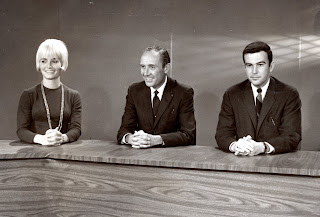


 Kay was an anchor at Channel 57 for a few years and received a lot of fan mail. For two months, Howard Wolff would only film her from the waist up because people were complaining about the mini-skirts. The Christian side of our fans was effective in keeping the status quo – skirts were too short!

“I wasn’t into saying anything off hand. I really wasn’t thinking about saying much of anything. I was busy making money and raising kids; that’s when I married Paul Vanston. He had two kids, so we had a total of six children that were less than eight years of age when we got married, and I worked two jobs. In a bizarre way, we didn’t come from a family that had money! That’s just how it is. Paul played music and worked. He was a system analyst for General Motors.

I really loved the creative end of my career. I loved taking pictures and the way I thought about advertising would make people stop and pay attention. A whole room of furniture standing in a box car in a junk yard demolished; I set up a whole room of furniture and I’d be dressed to the T. Of all of my ads you wouldn’t be expecting to see a furniture ad.  I won the biggest award for my work about a dining room chair and four buckle galoshes on all four legs.  The caption stated, “Don’t wait for the Spring season, Our prices are low Now!” It was just an isolated chair!


As far as people I’ve met, Gordie Howe is one of the most incredible people I’ve ever met – ever. He’s just a wonderful man. I recall the different people that have come through my life like Dick Wagner and Don Steele. I could go on and on about people I’ve met. I picked up Sonny and Cher at the airport. They came into Saginaw. I was at the radio station. They were just different. They had their own language. Glen Campbell was soft spoken and very religious. Jim Branster was a mountain of a man.  I did the radio for WKNX. He was a sweet kid and he loved sports. We would listen to the Lions when they were on the radio. We also attended the U of M football games. At the time, I was 34 and he was a robust guy. He picked me up and held me up and filmed the entire game. It was a U of M game.

Mark Fidrych was one of my favorite interviews. I’ll never forget it as long as I live. He said the “F” word every two words or so and I said, “Mark, this is going to be on television”. He said, “Ok”, and then went on to say “f” and “I had that effin Ball”etc. I interviewed Charlie Sanders and Gordie Howe. They were good people. Once Barry Sanders was in town, I wasn’t on television at the time but Mark helped arrange 20 minutes of pictures and an interview with Barry Sanders for my daughter Beth. He was so kind; Good times!


Kay is a confirmed music lover and In the mid-sixties, She got tickets for the Beatles of Olympia. She took her 14-year-old sister. It was a gift of a lifetime and it was the first time the Beatles played in Detroit. Kay was thrilled, “I had second row seats and I’ll never forget it as long as I live. I loved the Beatles. When I tell people I went to the first Beatles concert in Detroit and that they were one of the greatest bands ever.  Kay acknowledged that there are a lot of great artists that performed here in Saginaw.

 “I loved the harmonies of the Four Freshmen – I still have a poster! That was at the old Saginaw Auditorium. Paul Vanston was playing his jazz stuff. Before Four Freshmen came on with Joe Fryer opening – they all put on shaggy wigs and started playing those Beatle songs. That was just when the Beatles were coming out and before they became a phenomenon and people were making fun of them. They didn’t realize what brilliant musicians the Beatles were. Paul travelled with them for awhile. They were one of the greatest groups ever and I am a total Beatles fan. The musicians were up there and they played their hearts out. Paul would play a Treasure Island and everybody there was just getting drunk, not paying attention to the music.”

 Whites Bar was also part of the story.  Kay remembers when her dad drank beer and mom would call White’s Bar a Beer Garden. “If he stayed too long mom would say to us, “Go get your dad”. We lived on Morgan Street. I and my three older sisters would walk over to get my dad and bring him back home from White’s.”


Kay never thought of herself as a pretty girl. “It was interesting to me when I was in school that I never ever thought of myself as attractive. I just wanted to be smart. Being smart was more important to me. No one was ever unkind or pushy to me. It just came out now – my parents were very strict and I was not allowed to do anything, but they supported my activities. I was not allowed to go anywhere – not to any dances, though I did get to attend the prom in the 9th grade and later I was crowned Miss Anderson pool.  Perhaps it was kay’s early learning about relationships within the family that helped her sense of security in her adult life. Kay is modest yet confident. “I’ve had no problems of any kind with anybody.  In my adult life, especially with this last election with all the groping and blah, blah stuff with Trump and hitting on women; it happens all the time. I can’t even tell you how many times I’ve swatted someone’s hand away. I didn’t go on to report it but that is part of an ingrained sexism. That is what happens if you are a woman and you’re the only woman that’s with hundreds of men. You’re going to get that kind of thing. It went on a lot and it help keep me on my guard.. No one attacked me or raped me, it was just the old hitting on you stuff and trying to give you a big fat kiss with big wet fat faces. It was part of the game. I never had a drink until I was 42. I didn’t drink in High school. I wasn’t a goody-goody, I just didn’t like it.”


 After her work in television, Kay spent her next 37 years in Real Estate and she sold seven million dollars in commission. Like always, Kay learned her craft through hard work and a winning personality. She would never sell deficient real estate. She won plenty of commissions during her career. She was confident as a seller and she always negotiated with the buyer. “It made me happy that there was a lot of work that went into the sale and it gave me a lot of immense pleasure.”

Kay was the Dodge Girl and she did the printed advertisements for Saginaw Dodge. She was the queen of airbrushed ads. “I also got to know Bob Dyer, he was a mentor, a good man. He was extremely intelligent and he always encouraged me. He knew that sometimes it got rough; things that I had to say or do or go out on. He was really the reason I could sustain the pressure. My family was always primary.” Kay recalled lamenting that she was not able to balance income with financial stability. “I gave it all away because somebody needed it; they needed it more than I did.”  Kay charted a path in a male dominated industry and came back out with her head held high. The roar she experienced was the other side of silence wherein the good old boy network was shut off from awareness until pioneers like Kay Vanston began to jump into uncharted waters. At this point in her journey, Kay and other Zen architects know that we can get along better and love better because we don’t try to convert others. She has multi-perspective narratives and an appreciation for deeper relationships and appreciation of a history that looks beyond one’s own life. She realizes that one can love in many different ways and she can sense that art, music, sports and love are all part of the same thing. Kay Vanston is her own inner witness and it is felt as love and serenity

The Peace Train is calling.

Sunday, December 18, 2016

Book Review - Al Kooper Backstage Passes & Backstabbing Bastards


                             Backstage Passes & Backstabbing Bastards

                                  Memoirs of A Rock & Roll Survivor

By Al Cooper

The book is a longish 327 pages that include a two-page intro and a four-page preamble wherein Cooper identifies a five block stretch of Broadway in New York City especially 1619 Broadway (at west 48th), more commonly known as the Brill Building. Tin Pan Alley era flourished at the Brill Building (1930-1955). In the mid-fifties the Brill Building Sound took over @ 1650 Broadway. This is where Elvis Presley’s publishing were looked after. It was the base of operations for the Goodman family who handled the Arc Publishing Empire. They had a total lock on R&B and Blues with songs of Jimmy Reed, Muddy Waters, Willie Dixon, Chuck Berry and Howlin’ Wolf. Cooper certainly does his homework. He understands that British Invasion bands like the Stones, Dave Clark 5 and the Beatles recorded Arc songs to achieve a shaky cultural authenticity. As a wet behind the ears teenager, Cooper learned from some of the best songwriters on the planet including Goffin & King, Mann & Weil, Neil Sedaka and Howard Greenfield. Aldon Music was the premier song publisher from the early sixties onward. Cooper continued to improve his songwriting craft and by 1958 he was in demand as an up and coming instrumentalist and got a gig with the Royal Teens. They had a hit with a song entitled Short Shorts. Bob Gaudio of the Four Seasons was an original member!

Kooper is a natural born story teller who can split the truth to make a point. Early on he befriended Gene Pitney and he decries his involvement with Gary Lewis when he wrote This Diamond Ring, originally conceived as an R & B song for the Drifters. They declined and a west coast producer by the name of Snuff Garrett cut a “white” version of the song. It became a massive hit that started Gary Lewis & the Playboys down the road of bubblegum and pop music for teenagers who liked their rock sugary and sweet.

In 1965 Dylan was god. Tom Wilson produced Dylan and he allowed Kooper to observe the sessions for Subterranean Homesick Blues. The next session was called for the next afternoon. As Kooper recalls, “Taking no chances I arrived an hour early and well enough ahead of the crowd to establish my cover. Suddenly Dylan came in with Mike Bloomfield and the session got down to business. I told Tom Wilson that I have a great organ part for the song.” Wilson was distracted with other chores and it allowed Kooper to play that ham-fisted organ part without Wilson’s consent. Dylan liked it, so he told Wilson to turn the organ up. Wilson complained, “that cat’s not an organ player” but Dylan wasn’t buying it so he told Wilson, “Hey, don’t tell me who is an organ player and who’s not. Just turn it up. Kooper admitted that he waited until the chord was played by the rest of the band before he committed himself to play the verses. Kooper was always an eighth note behind. However, “Like a Rolling Stone” was pure magic and it was the linchpin for the album Highway 61 Revisited. To this day, Kooper insists his abilities are only adequate, even though he plays several different instruments. He is also an accomplished songwriter.

Kooper has an astonishing list of musicians with whom he’s known. He developed Blood Sweat & Tears, his first great band, only to walk away when the tension proved toxic. The later incarnations of the band never got the acclaim that the first Kooper-led aggregate. It seems that Kooper’s early BS&T work was visionary.  Child is Father to the Man was an incredible album that is still highly regarded by rock/jazz historians.

Along the way he championed Lynyrd Skynyrd and helped build their illustrious career. The leader and singer Ronnie Van Zandt was close to Kooper and they became a strong alliance that created the band’s persona, that of country gentlemen, a close knit band of brothers.

 It seems that Kooper was everywhere at once, in demand as a session player or a producer whether it was the Tubes, Nils Logfgren, Rick Nelson, Eric Clapton, or Pete Townsend. In 1980, Kooper collaborated with George Harrison and Ringo Starr at Harrison’s home studio to complete his new album. They were on their fourth night of recording when news broke at 10am. An hour later Lennon’s death was confirmed. The sessions continued even as Harrison was grieving. Harrison was white as a sheet, real shook up. Wine was gathered and somber tributes made. The sessions resulted in Harrison’s album Somewhere in England. Harrison composed a single entitled “All Those Years Ago.” It was a loving tribute to John Lennon. Kooper was on the session providing the Wurlitzer piano.

Kooper has been there and seen it all. He struggled with addiction and loved and lost too many times to count. He ended up in television with his friend Charlie Calello, a popular musician and guru who arranged all the Four Seasons and Lou Christie hits as well as Kooper’s Stand Alone LP. Kooper and Callelo created whole new careers when they got involved with a television show entitled Crime Story. It gave them both a new lease on life.

This is a page turner of a book, an incredible memoir that leaves no stone unturned. It is both irreverent, lurid, and loving.  If you like rock & roll, jazz, blues, and a good story, then buy this book. It is an updated version that is a page turner with plenty of photographs. You can find copies on Amazon at a good price.

Peace

Bo


The State of Music 2016 - You Might Be Surprised


                                            The State of Our Musical Union
                             Music Trumps Hairballs and Backroom Deals
By Bo White
For the life of me I cannot recall counting the coupe so viciously though I would scalp any low life billionaire who takes advantage of sloganeering and backroom deals in the name of progress. I’ve seen those people in grey with their feckless high-end uniforms, sartorial delights, and Viagra hard Eunuchs when they are just keeping up with appearances.  I’ve been down the road with the Kinks for forty-five years, loving their missteps, feuds, and musical faux pas.  It started with Arthur and took a hard left to Something Else and ended with Lola. I recently read a book about the Kinks written by Ray Davies. After a few hundred pages down road, it dawned on me that the book was incomplete; it went only to 1996, twenty years short of my goal of knowing the complete mania surrounding the kinkdom.
Oh, well. I’m not the man I used to be. I now get up at 4am, drive over to White’s Bar by 5am and I count all the money and laugh hysterically, maybe it’s the coffee. One thing I know for sure is there is a lot of great music in the Great Lakes Bay of Michigan.  Take Andy Reed, one of my musical heroes. He sent me three vinyl LPs including Always on the Run; The Legal Matters, Conrad; Relay Vol.1. I couldn’t imagine a better set of LPs since I love power pop, cool lyrics, and high harmonies. Reed is a musical institution in Michigan as well as parts unknown as the music drifts into the ether only to reappear when the aspects are right. I love Andy Reed because he is talented and honest. He doesn’t jump and jive and he offers no pretense to being pretty. I need to mention the Legal Matters recent vinyl release. It is an incredible piece of music and harmony plus it has a card so you can download some goodies.  The Legal Matters rocked the Magic Bag in Ferndale on November 5th, it is one of the last bastions of free world rock & roll!
The local scene is becoming more resilient due to the resurgence of White’s Bar. Allysha Guldenzoph is the manager and she has made White’s the place for great music and good vibes. There is a rotating group of singers/musicians who make the place hop from Michale Graves, Honesty & the Liars, Marsupial Creampie, David Asher’s DAB, Eastside Mike with Tommy Dolson and Chris, Joe Balbaugh, Tim Avram, The Mongrels, Charlie Klein, Margie & the Madness, Aaron Johnson Spout & the Orange, and the spirit of John Krogman, the man that made it all happen.
Chris Zehnder has been a compelling presence in the Music Scene in the Great Lakes Bay Region of Michigan. He cut his teeth with the Avery Set, a great band that was done too soon. College, travel, and life itself intervened to give Chris a wanderlust that served him well. Thus, Zehnder matured and blossomed as an artist. He can do rock, country, alternative and acoustic solo without blinking. He’s earned his stripes the hard way, moving out and moving forward but never leaving us behind. Chris provides the proof that great music continues to be designed. Thank god for Andy Reed, Donny Brown and the host of musicians that created this living document of great music.
Michael Robertson deserves a special mention. After dissolving Maybe August Michael and Roscoe Selley created some incredible music together. Michael is older and wiser. He’s embraced playing music in smaller venues (like White’s Bar) and continued to focus on music and lyrics. He is now working with Honesty Elliott on a regular basis and the marriage of musical ideas have flourished. Michael sings low to allow Honesty’s high harmonies to make a statement. The band’s photos are silhouetted in perfect sepia tones, Michael’s hair is windblown and impervious to the overgrown grasses and haggard trees. Incredible!
 Lumber Barons Fire Bar and Stable Martini Bar has entertainment 7 nights a week. The Bancroft Wine & Martini Bar has great drinks, Ladies Night, and music from their vinyl record collection. At times, they have live music with cool artists like Joel Rydecki, Andrew Kitzman, Avenue Acoustic and the Jim Pagel Jazz Trio.
Counter Culture is located on 620 Gratiot Avenue. They feature great live bands. They are the good guys!
Jeff Hall is still a fixture at Delta and continues to play beautiful music whether it’s tenor or baritone sax. He can play piano if you ask nice. Jeff was acquainted with Sonny Stitt through his gigs at Bakers Keyboard Lounge back in the seventies. It was a heady time for music, music was everywhere!
My last rock & roll concert was in Detroit and it featured my all time favorite singer/songwriter/musician Todd Rundgren. I loved the show. Rundgren took a page from each of his most well loved LPs including Todd, A Wizard; A True Star; Something /Anything? Back to the Bars. Good Stuff!
It was a great show that highlighted Rundgren’s ability to make the crowd stand up and pay attention. Well known players like Kasim Sulton and Prairie Prince were excellent and helped layer the harmonies. Rundgren performed his greatest songs such as Hello It’s Me, Just One Victory; I Saw the Light and Open My Eyes (Nazz). By the last third of the show I was beginning to tire, my energy was spent and I was nodding off and just when I got into a deep REM sleep, Rundgren started banging his drum and I awoke with a start. I had been dreaming of days gone by when Angelo Lorenzo was playing Sleepy Time Gal and Kenny Roberts was singing Going up the Country while Dick Wagner defrosted the Mystery Man and Question Mark danced through all those tears and through it all Lillie Gonzales took what she needed especially when Bobby Balderama played his guitar. Bob Seger is our hometown hero, he played Daniel’s Den in 1969 and came through White’s Bar with Tom Wechsler back in the seventies.
Peace
Bo White


Ray Davies Live In Detroit


                                           Ray Davies

                                        Solo In Detroit


It’s been a few years since we met, old friend. It was 1979 at Cobo Hall. You had just released Low Budget, your American album. And suddenly you were quite popular again and you found yourself playing arenas with a new muscular sound. Dave still played glorious yet precise heavy metal solos, not as sloppy as in the past, none of you were. You had a new haircut, short and athletic. You seemed trim and just a bit hyper, but so remote, not like in the past, back in ’70 at the Eastown when you revealed your whimsical and self-deprecating nature with that almost pastoral British charm. Hell, back then you could getaway with Harry Rag or Big Sky and just floor the audience with those incredible images. And you were so good at poking fun at yourself, your brother Dave, and the Kinks. But in ’79 you were a rock star in an arena band; imagine the KINKS…an arena band. It seemed that the Kinks got better, more proficient. But …damn, I missed the sloppiness and your irreverent British point-of-view. It was all to calculated, so serious. Something gained, something lost. I never thought it could ever return. In the nineties, your days were numbered and you seemed to retreat into your cocoon just as Dave got busy with an odd and delightful solo career.


 I missed his show a few years back at The Magic Bag in Detroit, not for any lack of trying, as soon as I heard about the Dave Davies Show I dialed up my friend Willie Wilson from WDET to get some special accommodation, i.e. tickets and Willie said he’d get me tickets but Dave’s show was yesterday and that I just missed it and that he drove Dave in from the Metro Airport and Dave was cool not as prickly as legend would have it. The Kinks are notorious, can’t remember any Michigan rockers from the sixties or seventies that had a good word to say about you guys, maybe it was just the times and maybe our remembrances have a plasticity that cushion our own shame at someone else’s expense, someone more famous and unable to defend himself. And maybe you were just a drunken roustabout. Well, I was a drunken man way back then, it doesn’t matter anymore because I’ve made peace with myself and I’ve come to terms with Ray Davies, the Kinks and fandom itself and judging from this performance I think he has found something too, like home and peace. I saw the Kinks six or seven times between 1970 and 1979 and though the Kinks group changed personnel several times during that era, I never saw him play without his brother. I know he misses him; I miss him too. I hope he’s OK. I heard he suffered a stroke a few years ago.


Davies opened the show with an indefatigable and irreverent version of Low Budget, his paean to American consumerism. Looking fit and trim, Davies inexplicably - as it was something like 90 degrees outside - wore a brown wool jacket over his shirt. He was sweating just a bit and dancing around like some deranged middle-aged dandy or a Kink or something and after a couple of songs he really got down to business removed his jacket and rolled up his sleeves. This cat is serious. He was here to rock and roll us - and to reveal a little bit more than just his songs. In fact, Davies said, “To understand my songs, you have to understand me”. So, True. Davies could have sung all night and most of the next day and still covered only a portion of his extensive catalog. Tonight, he included Where Have All the Good Times Gone, You Really Got Me, All Day and All of the Night, an incredible extended version of 20th Century Man (with some great slide licks from Mark Johns), and Tired of Waiting, the Punks favorite along with Till the End of the Day which he also performed.


Davies also played a few tunes that were never or rarely played in public including Dead End Street (an obscure Dickensian ode to class inequality) from 1967 that he turned into a playful call and response scat and go exercise and A Long Way from Home from 1970’s Lola vs Powerman and the Money-Go-Round. Davies said it was written for his brother Dave and it was about coping with the pressures of sudden fame. Davies narrated his performance with incredible anecdotes about Dave asking “What the Fuck is that”? after he first heard the riff to You Really Got Me; auditioning for record executives who hated their music, dismissing Dave’s guitar work as sounding like dogs barking. Davies remarked, “I thought that was a good thing”. A sound was born and the Kinks were part of that early vanguard but they changed and Davies brief solo acoustic set with Sunny Afternoon and Well Respected Man illustrated the changes, with satirical lyrics and universal themes that nonetheless poke fun at the writer himself, overall a good vibe with just a hint of regret. I was most interested in his new material from his first solo record, Other People’s Lives. I bought it and loved its quiet majesty. Don’t get me wrong, Davies still rocked on the record but it was a return to the more pastoral musings of Village Green Preservation Society, Big Sky, Autumn Almanac, and Waterloo Sunset (Davies’ masterpiece). He played several of the new songs including After the Fall, an older tune originally meant for the Kinks; the funky Tourist, about his life in New Orleans. In introducing Over My Head, a tune that begs the question “Is life Good to You?”  Davies revealed that it’s about acceptance and putting your life in perspective that it reflects upon his own life; a life like so many others - both comic and tragic. The Getaway is a moody gem inspired by Leadbelly and Davies skiffle days. Before performing Next Door Neighbor he asked to no one or everyone, “Do you want to be my friend?”; he repeated the question and then said, “Let’s go out and you can have a few drinks with me and then you’ll see how it works.” That aside Davies possessed a self-deprecating charm, oddly endearing and so loveable. He took performance art to a deeper level – especially for rock n’ roll – and simply and exquisitely charmed the pants off the crowd. He closed the 90-minute set with Lola, a classic song that he could never sing, seems he wrote it out of his range. Where’s brother Dave when you need him? Still, Davies proved he is a master, a songwriting genius that has grown comfortable with the stage. This was an inspired performance that was strangely reassuring. Maybe I’m not obsolete after all. I left the Taste Fest feeling renewed and enlivened. My wife Lisa and I hailed a cab and returned to our room at The Hilton Inn on Gratiot Avenue, laughing and goofing around.  It was a good night GOD SAVE THE KINKS. I arose early the next morning, a good hour or so before Lisa. I showered and then brewed some of that complimentary individually packaged coffee that tastes bad but turns the lights on, so I drink it anyway and I get fired up and I decide to take a stroll down Gratiot over to Ford Field and Comerica Park. I’d never seen these stadiums, homes to the Detroit Tigers and Detroit Lions. The terrible over-the-top opulence stunned me, steel and concrete monuments to our cultural constipation and diversion as a way of life. I shivered at those lavish modern pyramids and wondered what future generations would think of us. I was alone on Gratiot as I turned toward the Fox Theatre. There were only a few random people around the corner, some shirtless, some with shoes but no socks; one missing a few teeth. As I walked back toward the Hilton, I noticed a young man with his head in his hands, sitting on the church steps, oblivious to my passing eye. I imagined that something happened to him and I wondered if I should say something but I didn’t bother. I was afraid for some reason but I shook off those awful thoughts like a cold chill and continued walking. After awhile I started to feel invigorated by the morning sun and felt the quiet pulse of the city begin to pick up before the hustle and bustle returned to the streets. I went back to my hotel room and told my wife about all these things. She smiled and kissed me softly. It was time to go home.